
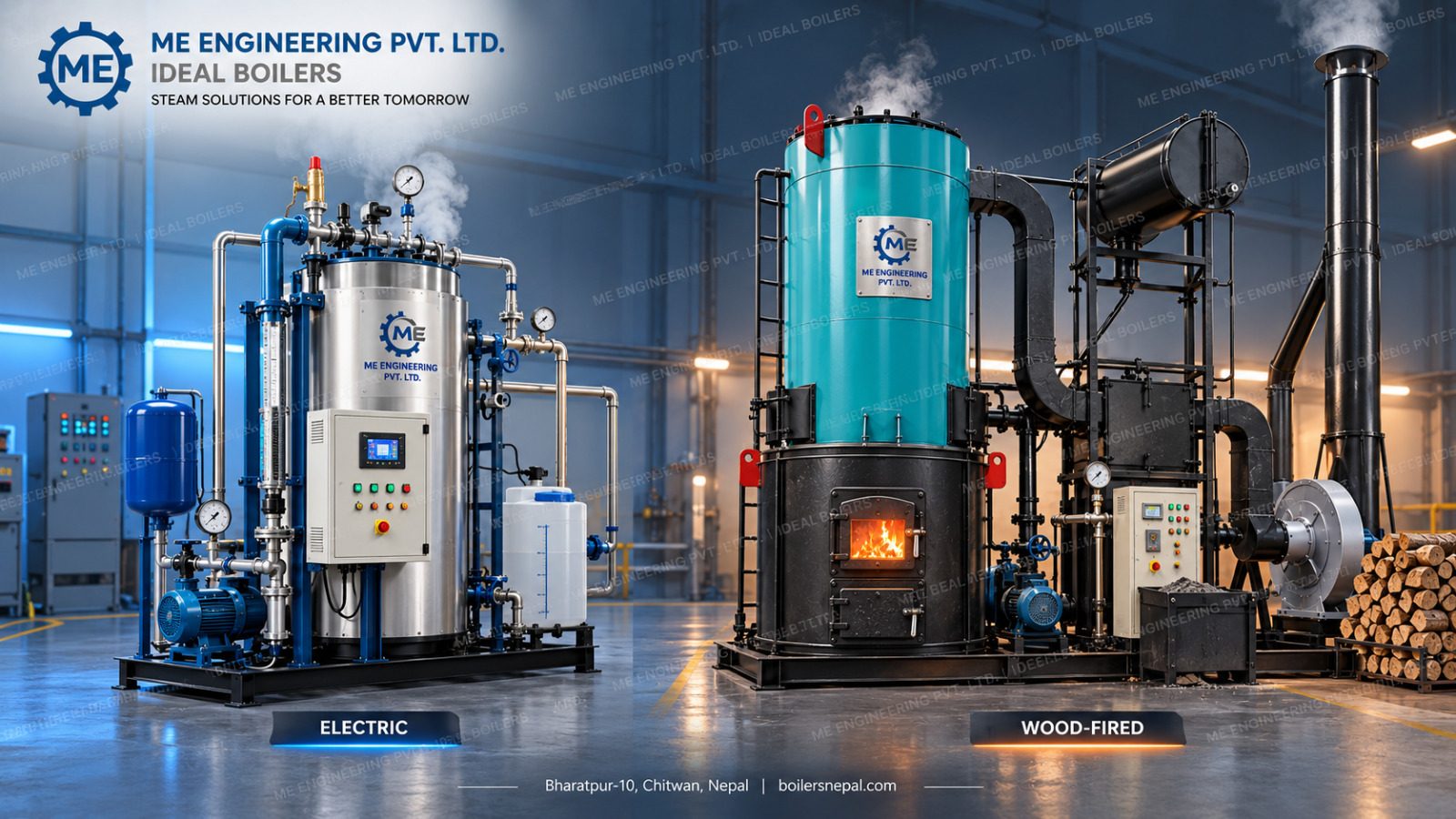
Which is cheaper: an electric or a wood-fired 500 kg/hr steam boiler?
At the prices in this comparison (electricity NPR 10.50/kWh, wood NPR 10-15/kg) and a 10-hour operating day, a 500 kg/hr wood-fired steam boiler is cheaper than an electric one on both quoted purchase cost and daily fuel cost. Electric energy costs NPR 42,000 per day, while wood costs NPR 12,000 to NPR 20,250 per day. Electric boilers are cleaner, more compact and easier to automate, so the right choice depends on your priorities as well as cost.
This article compares the two options for a 500 kg/hr plant running 10 hours a day, 300 days a year. The cost reference date is 11 July 2025, using prices supplied for this comparison.
How we calculated the running cost
Electric boiler. The boiler needs about 375 kW of useful energy. With pumps and other losses, total electrical demand is 400 kW.
| Item | Calculation | Result |
|---|---|---|
| Hourly electricity use | 400 kW x 1 hour | 400 kWh |
| Hourly energy cost | 400 kWh x NPR 10.50 | NPR 4,200 |
| Daily energy cost | 4,000 kWh x NPR 10.50 | NPR 42,000 |
| Steam per day | 500 kg/hr x 10 hours | 5,000 kg |
| Energy cost per kg of steam | NPR 42,000 / 5,000 kg | NPR 8.40 |
Wood-fired boiler. The same 375 kW of useful steam duty is converted into fuel. We assumed air-dry wood at about 3,500-4,000 kcal/kg (4.07-4.65 kWh/kg) and 70% boiler efficiency. This gives roughly 115-132 kg/hr, rounded to a budgeting range of 120-135 kg/hr.
| Case | Wood use | Wood price | Daily fuel cost | Cost per kg of steam |
|---|---|---|---|---|
| Low | 120 kg/hr | NPR 10/kg | NPR 12,000 | NPR 2.40 |
| Midpoint | 127.5 kg/hr | NPR 12.50/kg | NPR 15,938 | NPR 3.19 |
| High | 135 kg/hr | NPR 15/kg | NPR 20,250 | NPR 4.05 |
Actual wood use depends strongly on moisture content, so confirm it with a supplier guarantee and a fuel test.
Initial capital cost
| System | Component | Supplied price |
|---|---|---|
| Electric | 500 kg/hr electric steam boiler | NPR 5,850,000 |
| Electric | 400 kVA transformer | NPR 4,500,000 |
| Electric | Installation | NPR 1,150,000 |
| Electric | Quoted subtotal | NPR 11,500,000 |
| Wood | 500 kg/hr wood-fired steam boiler | NPR 2,587,000 |
| Wood | Installation | NPR 1,250,000 |
| Wood | Quoted subtotal | NPR 3,837,000 |
The electric package is NPR 7,663,000 higher on quoted prices. The wood option will cost more once you add the boiler house, fuel yard, chimney and other site works. Those extra works would need to exceed the whole NPR 7,663,000 gap before electric becomes cheaper at installation.
Transformer note. A 400 kVA transformer is marginal for a continuous 400 kW load. At 0.95 power factor, 400 kW needs about 421 kVA. With a 20% design margin, that rises to about 505 kVA. Ask a qualified electrical engineer and the utility whether 500 kVA or 630 kVA is required, especially if other factory loads share the transformer.
Annual and five-year cost
Annual figures assume 300 operating days (3,000 hours per year) and include energy or fuel cost only.
| Measure | Electric | Wood low | Wood midpoint | Wood high |
|---|---|---|---|---|
| Annual cost | NPR 12,600,000 | NPR 3,600,000 | NPR 4,781,250 | NPR 6,075,000 |
| Annual saving vs electric | - | NPR 9,000,000 | NPR 7,818,750 | NPR 6,525,000 |
Quoted capital plus cumulative energy or fuel cost:
| Period | Electric | Wood range |
|---|---|---|
| Year 0 | NPR 11,500,000 | NPR 3,837,000 |
| Year 1 | NPR 24,100,000 | NPR 7,437,000 to NPR 9,912,000 |
| Year 3 | NPR 49,300,000 | NPR 14,637,000 to NPR 22,062,000 |
| Year 5 | NPR 74,500,000 | NPR 21,837,000 to NPR 34,212,000 |
| Year 10 | NPR 137,500,000 | NPR 39,837,000 to NPR 64,587,000 |
These totals exclude wood-only costs such as operator labour, maintenance, ash disposal and fan power. They also exclude electric-only costs such as utility demand charges and power-factor penalties. For electric to be cheaper within five years, those wood-only costs would have to exceed NPR 40,288,000 to NPR 52,663,000.
When does an electric boiler become the cheaper choice?
Under the base inputs, an electric boiler has no financial payback against wood. It only breaks even if one or more inputs change a lot:
| Break-even measure | Calculated threshold |
|---|---|
| Electricity tariff (before wood overheads) | NPR 3.00-5.06/kWh |
| Wood price (before wood overheads) | NPR 31.11-35.00/kg |
| Wood-only costs over five years | At least NPR 40,288,000 |
If you add an illustrative NPR 200 per operating hour for wood-only operator, maintenance, ash and auxiliary costs, the break-even tariff rises to NPR 3.50-5.56/kWh. The wood-price threshold falls to NPR 29.63-33.33/kg. Replace this allowance with your own actual records.
Factors that can strengthen the electric case:
- A negotiated off-peak, captive-hydropower or other low effective electricity tariff.
- Short, intermittent production, where instant start-stop avoids warm-up and standby losses.
- High value on floor space otherwise used by a boiler house, chimney and wood yard.
- High labour, transport, fire-control, ash-disposal, downtime or emissions-compliance costs for wood.
- Processes where smoke, dust or fuel handling creates hygiene or product-quality risk.
- High condensate return and hot feedwater, which reduce the kWh needed per kg of steam.
Safety, space and environment compared
| Criterion | Electric boiler | Wood-fired boiler |
|---|---|---|
| Start-up and control | Fast start, staged control, easier automation | Slower response; fuel feed and combustion need active control |
| Space | Compact; no wood yard, ash area or chimney | Larger footprint for boiler, fans, chimney, fuel stock and ash |
| On-site emissions | None from combustion; grid emissions are indirect | Particulate matter, smoke, CO, NOx and ash need control |
| Maintenance | Water quality, blowdown, elements, contactors, controls, pumps | Tube and soot cleaning, refractory, grate, fans, ducts, chimney |
| Staffing | Simpler routine operation | Continuous fuel handling and combustion supervision |
| Reliability exposure | Depends on stable power, transformer and switchgear | Depends on wood quality, fuel stock and mechanical condition |
| Noise and housekeeping | Generally quieter and cleaner | More noise, soot and ash housekeeping |
An electric boiler is simpler and cleaner at the point of use, but it is not hazard-free. Both types are pressure equipment and need certified protection devices, water-level controls, safe blowdown, planned inspection and trained operators. Electric systems also need correct short-circuit protection, interlocks, earthing and arc-flash controls. Water treatment is critical for both, because scale reduces heat transfer and can damage pressure parts or overheat elements.
Our recommendation
| Your priority | Best choice | Condition |
|---|---|---|
| Lowest direct cost at 10 hours per day | Wood-fired | Enough space, compliant emissions control, reliable dry wood supply, trained labour and maintenance capability |
| Cleanest and simplest plant | Electric | Compact installation, clean production, quick response and automation matter, and you accept the energy-cost premium or can secure cheaper electricity |
| Balanced option | Wood for base load plus a smaller electric unit | For start-up, low-load production or standby. Needs a separate hybrid design and capital review |
What to confirm before you buy
- Steam pressure, feedwater temperature, condensate return percentage and hourly load profile.
- Guaranteed electric consumption in kWh per tonne of steam, and guaranteed wood consumption at a stated moisture content.
- A utility quotation for transformer size, connection, demand charge, fixed charge, tariff category and outage history.
- Prices for the wood boiler house, foundation, chimney, fuel store, fire protection, electrical auxiliaries and ash area.
- Your actual operator salary, maintenance records, cleaning frequency, consumables and ash-disposal cost.
- A supplier performance test, comparing total cost per tonne of steam under the same feedwater and steam-pressure conditions.
For help sizing and costing a steam boiler for your plant, contact ME Engineering (contact details: confirm with owner).