
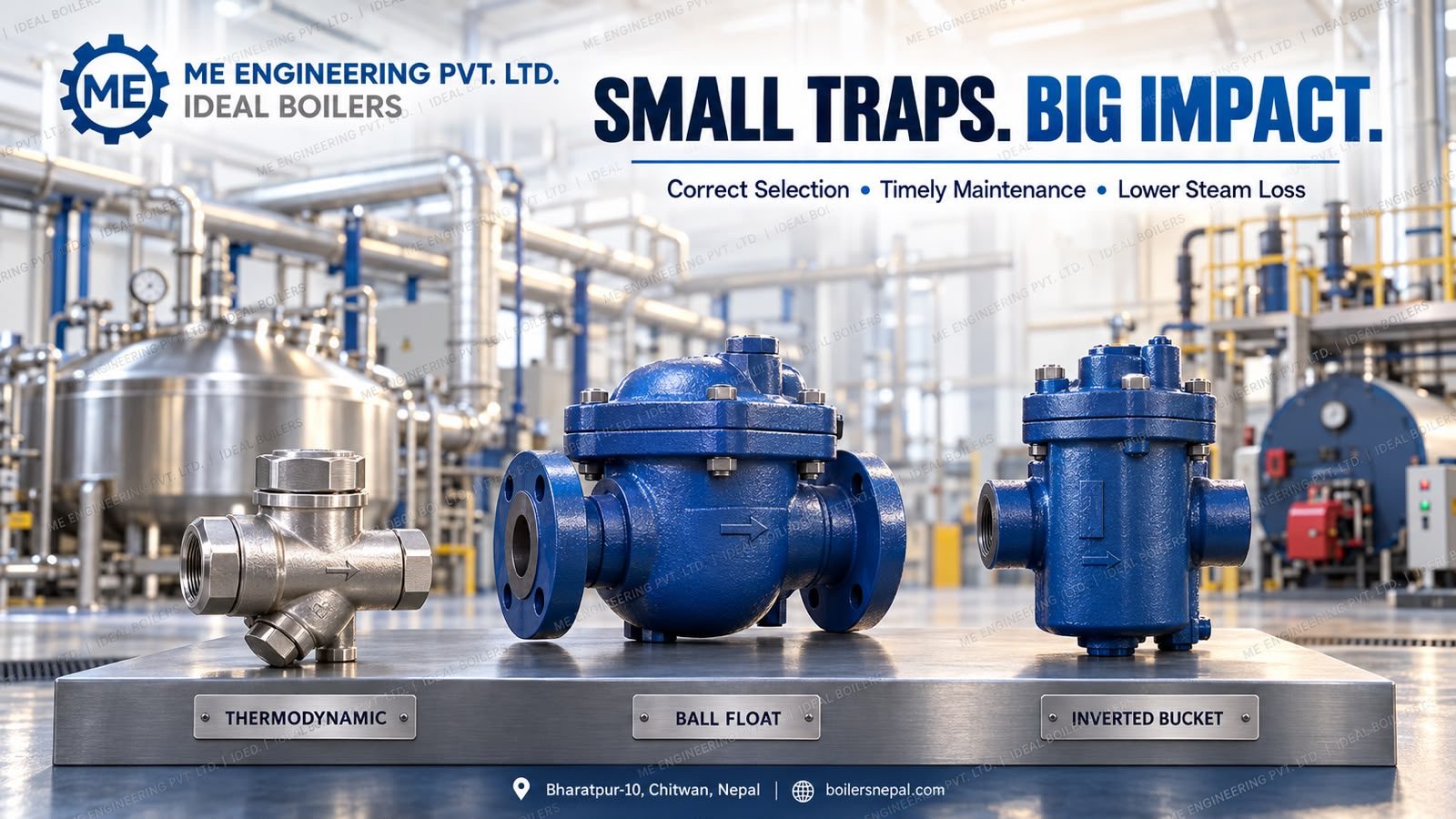
What is a steam trap and what must it do?
A steam trap is a small automatic valve that discharges condensate and air from a steam system while holding back useful live steam. A failed or wrongly selected trap wastes steam, slows heating and makes a boiler run harder than the process needs.
Many industries use far less steam in production than the boiler's rated capacity, yet the boiler keeps firing, consuming fuel or electricity, taking in make-up water and running longer than expected. A failed or wrongly selected steam trap can be one of the hidden causes. It is not the only possible cause, so the whole steam system should be audited, but traps are one of the first places to check.
A correctly designed trapping point must:
- remove condensate at the rate it forms, including the heavier start-up load;
- release air and other non-condensable gases that delay heating;
- prevent live steam from passing into the condensate-return system;
- operate at the available differential pressure, not simply the boiler or header pressure; and
- remain reliable under real site conditions, including dirt, water hammer, backpressure, steam locking and load variation.
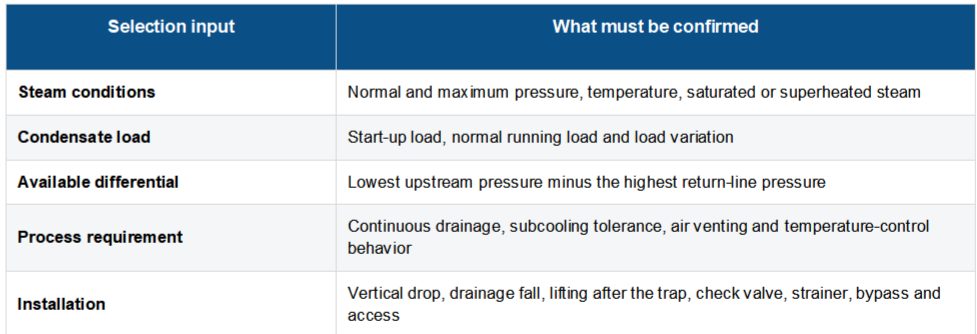
Pressure rating is only one part of trap selection. Condensate load, start-up load, downstream pressure, air-venting requirement, installation orientation, return-line arrangement and maintenance access are equally important.
Why the boiler can run harder than the process demand
When production demand is low but boiler firing or electrical input stays unexpectedly high, steam is being lost, returned inefficiently or used with poor heat transfer. Steam traps can contribute in several ways.
| Trap condition | What happens in the system | Operational effect |
|---|---|---|
| Failed open or blowing | Live steam passes directly into the condensate line. | The boiler replaces lost steam continuously, increasing energy, water and treatment demand. |
| Failed closed or undersized | Condensate backs up in the equipment or steam main. | Heat-transfer area floods, warm-up slows, production time increases and water-hammer risk rises. |
| Poor air venting | Air forms an insulating layer and occupies steam space. | Heating becomes slow or uneven even when the pressure gauge appears normal. |
| Wrong differential-pressure basis | The trap cannot discharge against actual backpressure. | Equipment stalls, temperature control becomes unstable and operators may increase pressure or run time. |
| Wrong installation or group trapping | Condensate cannot reach or pass through the trap correctly. | Some equipment floods while other equipment receives excess steam, hiding the real demand pattern. |
Selecting the right trap for the application
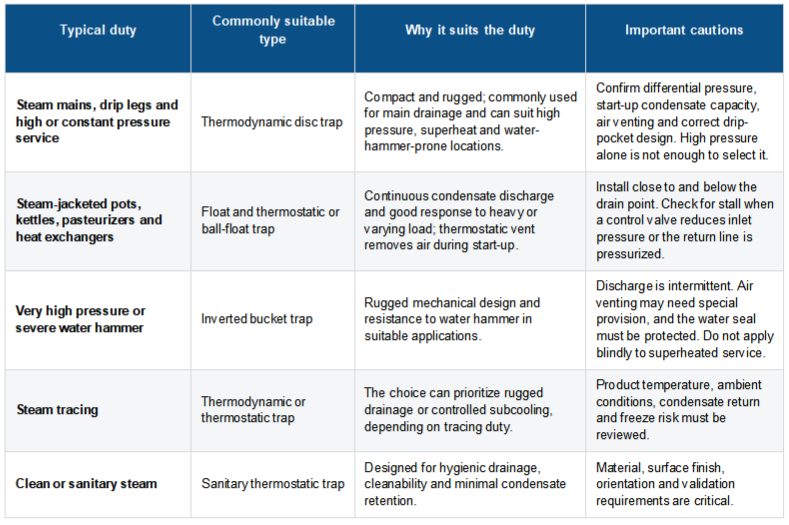
There is no single steam trap that is best everywhere. The correct choice is the trap whose operating principle matches the duty.
Thermodynamic traps on steam mains
Thermodynamic disc traps are often a strong choice for steam-main drip points, especially where the pressure is relatively high or constant and a compact, rugged trap is needed. They tolerate demanding environments and are widely used on distribution lines. However, the trap must still be selected from the manufacturer's capacity data at the minimum expected differential pressure. Long inlet lines, poor drip pockets, excessive backpressure or inadequate air venting can defeat an otherwise suitable trap.
Ball-float traps on pots and kettles
Steam-jacketed kettles and process vessels may generate a high condensate load during start-up and a smaller, continuously changing load during production. A float and thermostatic trap is commonly preferred because it drains condensate continuously and vents air automatically. Keeping the heating surface clear of condensate improves heat transfer, temperature control and batch consistency.
When an inverted bucket trap is considered
An inverted bucket trap can be a robust alternative where pressure is very high or water hammer is severe. Its suitability depends on the application. Because it discharges intermittently and relies on a water seal, air venting, superheat exposure, steam locking and installation layout must be checked carefully.
Why a cheap generic trap can become the expensive choice
The purchase price of a steam trap is visible. The cost of a poor trap is usually hidden in the monthly fuel or electricity bill, make-up water, chemicals, production delay and maintenance hours. A low-priced trap without verified capacity, pressure rating, material quality, seat tightness or spare support may save money on the purchase order while increasing the plant's total cost.
A realistic life-cycle comparison should include:
- initial purchase and installation cost;
- functional steam loss during normal operation;
- steam loss after wear or failure;
- inspection, repair, spare and replacement cost;
- lost production or slow batch heating;
- additional make-up water and water-treatment chemicals; and
- the effect of low condensate return on feedwater temperature and boiler efficiency.
One failed-open trap can create a measurable boiler load
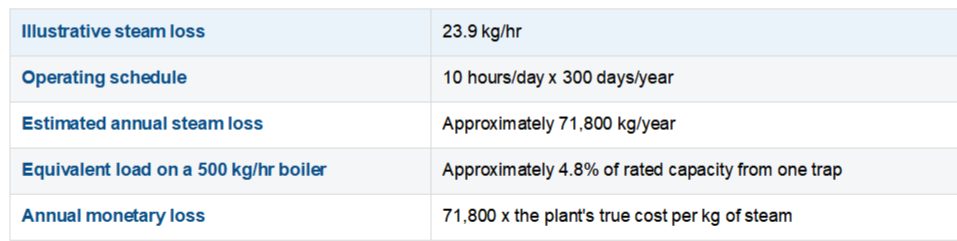
The U.S. Department of Energy provides an illustrative leakage table for a failed-open trap discharging through an orifice to atmospheric pressure. At 100 psig, approximately 6.9 barg, a 1/8-inch opening is estimated to lose 52.8 lb/hr, or about 23.9 kg/hr, of steam.
This is an illustration, not a universal loss figure. Actual leakage depends on the trap's failure opening, steam pressure, downstream pressure and operating pattern. The calculation nevertheless shows why a boiler can appear to be overfed or overrun even when useful process demand is modest. Several failed traps can create a substantial artificial load.
When should a steam trap be repaired or replaced?
A trap should be investigated promptly when any of the following is found:
- continuous live-steam blow-through;
- failure to discharge condensate at start-up or under full load;
- repeated water hammer, temperature instability or unusually slow heating;
- erosion, cracked body, damaged seat, blocked strainer or internal corrosion;
- a trap type, capacity, pressure class, material or orientation that does not match the application;
- repeated repair with a short interval between failures; or
- a life-cycle cost showing that continued leakage is more expensive than replacement.
Replacement should be based on confirmed diagnosis. Surface temperature alone can be misleading because a correctly operating trap may cycle, discharge hot condensate or be affected by flash steam. Ultrasonic testing, temperature measurement, operating-pattern observation and process information should be interpreted together.
A practical steam-trap management programme
- Create a trap register. Give every trap an identification number and record its location, application, type, size, pressure class, normal pressure, return pressure and discharge arrangement.
- Verify selection. Calculate start-up and running condensate loads, apply the manufacturer's recommended safety factor and confirm capacity at the minimum differential pressure.
- Inspect systematically. Check critical and high-loss traps more frequently or monitor them online. A complete site survey at least annually is a practical baseline for many plants, adjusted according to risk, pressure and operating hours.
- Prioritize by loss and production risk. A large failed-open trap on a high-pressure main and a blocked trap on critical process equipment deserve immediate action.
- Repair or replace and retest. Confirm the new or repaired trap's operation after the system stabilizes. Do not treat installation as proof of performance.
- Track results. Monitor boiler fuel or electricity per tonne of product, make-up water, condensate-return rate, boiler running hours, pressure stability and repeat trap failures.
Information required before selecting a trap
The business case is simple
A steam trap should not be purchased as an isolated fitting. It should be selected as part of the complete steam and condensate system. The correct trap keeps heating surfaces active, protects the piping, supports stable temperature control and prevents valuable live steam from disappearing into the return line.
Timely inspection and replacement are therefore operating decisions, not minor maintenance expenses. A reliable trap with the correct design and capacity can repay its higher initial cost through lower steam loss, shorter heating time, improved condensate recovery and fewer production interruptions.
If a boiler appears to be working harder than the plant's real steam demand, do not assess the boiler alone. Survey the steam traps, distribution piping, insulation, pressure-reducing stations, condensate-return system and blowdown practices together. The boiler can only be as efficient as the system it serves.
Frequently asked questions
Are thermodynamic steam traps always the best choice for high-pressure lines?
No. They are commonly suitable for steam-main drainage and many high-pressure or constant-pressure applications, but final selection must consider condensate load, differential pressure, backpressure, air venting, superheat and piping layout.
Which steam trap is usually suitable for a steam-jacketed kettle?
A float and thermostatic or ball-float trap is commonly preferred because it can discharge heavy and varying condensate loads continuously while venting air. Very high pressure, severe water hammer or unusual return conditions may justify another design.
Can one failed trap noticeably affect a 500 kg/hr boiler?
Yes. In the DOE illustration, a 1/8-inch failed-open path at 100 psig loses about 23.9 kg/hr, equivalent to approximately 4.8% of a 500 kg/hr boiler's rated output.
How often should steam traps be tested?
Use a risk-based schedule. Critical, high-pressure or high-loss traps require more frequent checks or online monitoring. A site-wide annual survey is a practical baseline for many plants, with shorter intervals where operating conditions are severe.
Is the cheapest steam trap the lowest-cost option?
Not necessarily. Purchase price is only one part of life-cycle cost. Steam leakage, service life, repair frequency, production loss and condensate-recovery performance can make a low-priced but unsuitable trap much more expensive.
Contact ME Engineering and technical references
ME Engineering Pvt. Ltd. and Ideal Boilers support industrial steam users with application review, steam-trap selection, installation planning and improvement of boiler, steam-distribution and condensate-return systems.
ME Engineering Pvt. Ltd. | Ideal Boilers Bharatpur-10, Chitwan, Nepal boilersnepal.com
Technical references
This article is based on established steam-system guidance. Application-specific engineering should still be completed before selecting or replacing equipment.
- U.S. Department of Energy, Inspect and Repair Steam Traps, Steam Tip Sheet 1
- U.S. Department of Energy, Improving Steam System Performance: A Sourcebook for Industry
- Spirax Sarco, Considerations for Selecting Steam Traps
- Spirax Sarco, Selecting Steam Traps for Process Equipment
- TLV, Steam Trap Selection Safety Factor and Life Cycle Cost
- TLV, How Mechanical Steam Traps Work
Note: the leakage example is illustrative and does not replace a plant-specific steam-loss calculation or trap survey.